by Jerrold Bartholomew on May 21, 2008
 Gertie Brooks, a columnist for my local paper, the Tri-City Times, has written an interesting column on the origin of ‘Taps’. I have no idea if the history is accurate, but Gertie seems a trustworthy source and the story, while astounding, explains much. ‘Taps’ apparently originates from the civil war and a story worthy of ancient tragedy:
It all began in 1862 during the Civil war when Union Army Captain Robert Ellicombe was with his men near Harrison’s Landing in Virginia. The Confederate Army was on the other side of the narrow strip of land. During the night, Captain Ellicombe heard the moan of a soldier who lay mortally wounded on the field. Not knowing if it was a Union or Confederate soldier, the Captain decided to risk his life and bring the stricken man back for medical attention. Crawling on his stomach through the gunfire, the Captain reached the stricken soldier and began pulling him toward his encampment.
For the rest of the story click here.
For a variety of reasons–a relative’s health problems, the recent passing of a client–I find myself all the more appreciative of life in general. It is one blessing of working with the elderly generally that I am often reminded of life’s preciousness, and working with veterans in particular helps me to know the extent of the sacrifices our veterans have made. To all of our veterans and their families, thank you.
UPDATE: The History Channel offers a very different story on the origin of ‘Taps’ that can be found here.
by Jerrold Bartholomew on May 19, 2008
The reality is that families faced with the chronic illness or disability of a loved-one often have few options but a traditional long-term care facility. Aside from the financial devastation that this usually entails, there is the fact that a traditional nursing home is a difficult place to be in. It is good therefore to see nursing home alternatives emerging, such as described in this story about a new nursing home developing near Grand Rapids, Michigan:
Differing from a traditional “hospital-style” nursing home, the so-called green house concept features smaller facilities designed to create a home-like setting with private rooms, baths and other amenities. Residents still receive the daily assistance and medical care they need, though their activities are not regimented nor predicated on their medical needs.
While the article is silent on the cost of care at this facility, it is not unreasonable to assume that it will be more expensive than traditional nursing home care. If it were otherwise, the article would be trumpeting both higher quality care and lower costs. The fact is that this sort of care remains out of reach for most seniors whose savings would be quickly depleted by the cost of this higher level of assistance. Perhaps the best chance most seniors will have at this sort of care is begin planning early in order to maximize assets.
by Jerrold Bartholomew on May 13, 2008
 The same technology that allows coffee and internet afficiandos to stay in one cafe for hours on end is now helping seniors to retain their independence and cope with serious health issues. A new Wi-Fi device is capable of alerting your physician in case of heart attack. Thoughtful implementation of new technologies offers a great deal of promise for those seeking to remain independent for as long as possible. Similar technologies offer the promise of helping seniors remain independent as long as possible. Advances in home design and remodeling are likewise helpful to seniors who wish to age in place.
by Jerrold Bartholomew on May 6, 2008
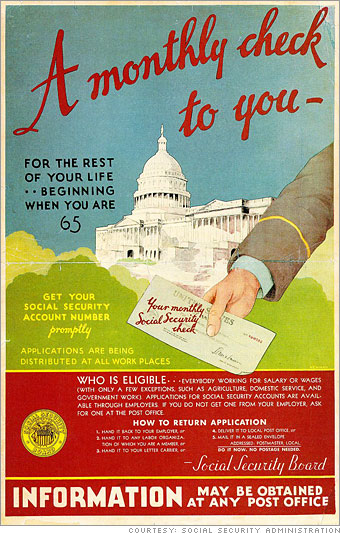 One very important matter for retiring seniors is the decision of when to begin receiving social security benefits. This helpful calculator from AARP can help in the decision-making process. But be forewarned: there is a lot of information on the internet suggesting that you should delay receiving benefits as long possible. And this is not without some merit as your benefits will be higher and theoretically provide better cashflow through your retirement the longer you wait to begin receiving benefits. However, in many cases the modest monthly gain for waiting is not offset by the years of foregone benefits. Consider it this way: If you retire at 65 with a household income of about $50,000.00, you can immediately begin receiving about $1,750.00 per month. If you choose to wait until age 67 to begin receiving social security, your monthly benefit will be about $1,988.00 per month. Think you should wait for the extra $238.00 per month? Well, in order to receive that additional $238.00 per month, you will not receive $42,000.00 in benefits ($1750.00 x 24 months = $42,000.00). The additional $238.00 per month will take you a little more than 176 months to make up the difference between the total of what you would have received with the earlier election and waiting to have the higher monthly payout.
by Jerrold Bartholomew on May 4, 2008
 Several reforms to Michigan’s Blue Cross Health Insurance are currently pending in the Michigan Legislature. Proponents hope that these reforms will help reduce the costs of health care in Michigan, while advocates for the health insurance industry voice concerns about declining revenues and increased costs. The issues are complicated, but it seems fair to say that health care is only getting more expensive as the system continues to absorb the shock of a growing retiree population. [click to continue…]
by Jerrold Bartholomew on April 25, 2008
 A recent article in The Economist explained how some senior citizens used Facebook to fight back when their investments in Asset Backed Commercial Paper ended up in bankruptcy court. Sometimes the innovations wrought by the internet can be a little startling, even if pleasantly so. The idea that a broad spectrum of investors, including many elderly, might form a coalition on Facebook and force a corporation to hear (and heed) their complaints is an astonishing example of how much has changed. Not only has the internet brought people together in wonderful new ways, but the phenomenon has spread to all parts of society, including the elderly:
Following the example of their children and grandchildren, some small investors formed a group on Facebook, a social-networking site, to trade information, provide mutual support and plot strategy. Brian Hunter, the group administrator, says the site turned out to be an “amazing tool”. People who would never have met in real life, from pig farmers and retired loggers to MBA students and pastors, created a formidable interest group.
I find the internet a fascinating world of possibility. There is no limit to the connections that can be formed or the information that can be harnessed. Although written several years ago (and updated more than once) I would recommend The World is Flat to anyone hoping to see the breadth of what has changed through the influence of the internet.
by Jerrold Bartholomew on April 24, 2008
 Sue Schiebel has written an excellent article on Medicaid Planning. While her article concerns MassHealth, which is the Massachusetts Medicaid program, the rules and ideas explained are the same in Michigan. She writes:
A lot of middle-aged people don’t realize Medicare, the federal health insurance program, pays for a very limited amount of skilled nursing home care. As we live longer, that means more of us will have to spend our own money for long-term care or must rely on MassHealth, the state health insurance for low income people. Many people wind up doing both — first using up many of their own assets to “spend down” to Medicaid limits so they are financially eligible for state help.
Medicaid qualification is a complex area of the law. To highlight just one counter-intuitive aspect, consider that donations to a church or charity are treated as gifts under the law. One making such a gift is technically creating a period of ineligibility for Medicaid. Strictly speaking, a person making significant donations to a church could be ineligible for Medicaid for several months after all other assets have been spent down. An elder law attorney helps families cope with these bizarre rules and avoid such unfortunate results.
by Jerrold Bartholomew on April 24, 2008
 Many of my clients are uneasy about placing their assets into a trust as part of an asset protection plan. In order to demystify the process and help you understand why you might consider having a trust drafted for your specific needs, I would like to explain some of the reasons you might consider having a trust and little bit of how a trust works.
Trusts are an important part of elder law and estate planning. Elder law is really the art and science of preserving personal and financial independence for seniors. Many forces threaten a senior’s independence, from ailing health to limited finances to extensive regulatory systems. The goal in creating comprehensive estate plans is to extend resources as much as possible and to create options. How is this possible? The right trust agreement is an important tool for achieving this goal.
[click to continue…]
 The
The